- Get link
- X
- Other Apps
How Blockchain Transaction Works?
Step 1) Some person requests a group action. The group
action can be concerned cryptocurrency,
contracts, records or different info.
Step 2) The requested group action is broadcasted to a P2P network with the assistance of nodes.
Step 3) The network of nodes validates the group action and therefore the user's standing with the assistance of famed algorithms.
Step 4) Once the group action is complete the new block is then superimposed to the present blockchain. In such the simplest way that's permanent and unalterable.
Step 2) The requested group action is broadcasted to a P2P network with the assistance of nodes.
Step 3) The network of nodes validates the group action and therefore the user's standing with the assistance of famed algorithms.
Step 4) Once the group action is complete the new block is then superimposed to the present blockchain. In such the simplest way that's permanent and unalterable.
Learn more knowledge on Blockchain Online Training.

Why can we like Blockchain?
Here, are some reasons why Blockchain technology has become so common.
Resilience: Blockchains is usually replicated design. The chain remains operated by most nodes within the event of a vast attack against the system.
Time reduction: within the monetary trade, blockchain will play a significant role by permitting the faster settlement of trades because it doesn't would like a long method of verification, settlement, and clearance as a result of one version of agreed-upon information of the share ledger is accessible between all stack holders.
Reliability: Blockchain certifies and verifies the identities of the interested parties. This removes double records, reducing rates and accelerates transactions.
Unchangeable transactions: By registering transactions in written account order, Blockchain certifies the unalterability, of all operations which imply once any new block has been superimposed to the chain of ledgers, it can't be removed or changed.
Fraud forestalling: The ideas of shared info and accord prevent potential losses thanks to fraud or defalcation. In logistics-based industries, blockchain as an observance mechanism act to cut back prices.
Security: offensive a standard info is that the transportation down of a particular target. With the assistance of Distributed Ledger Technology, every party holds a replica of the first chain, that the system remains operative, even the big variety of different nodes fall.
Transparency: Changes to public blockchains are publically seeable to everybody. This offers larger transparency, and every one transaction are changeless.
Collaboration: permits parties to interact directly with one another while not the necessity for mediating third parties.
Decentralized: There are standards rules on however each node exchanges the blockchain info. This methodology ensures that each one transaction are valid, and every one valid transaction superimposed one by one.
Blockchain versions
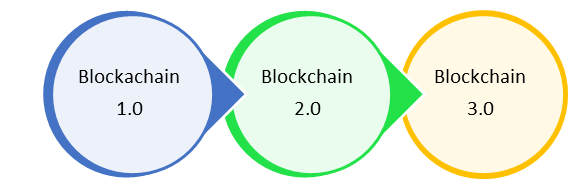
Blockchain one.0: Currency
The implementation of DLT (distributed light-emitting dodger technology) led to its 1st and obvious application: cryptocurrencies. this enables monetary transactions supported blockchain technology. it utilized in currency and payments. Bitcoin is that the most distinguished example during this phase.
Blockchain two.0: good Contracts
The new key ideas are good Contracts, little pc programs that "live" within the blockchain. they're free programs that execute mechanically and check conditions outlined earlier like facilitation, verification or social control. it's used as a replacement for ancient contracts.
Get more knowledge through the Blockchain Online Course.
Blockchain three.0: DApps:
DApps is associate degree abbreviation of suburbanized application. it's their backend code running on a suburbanized peer-to-peer network. A Dopp will have frontend code and user interfaces written in any language that may create a decision to its backend, sort of an ancient Apps.
Blockchain Variants
Blockchain three.0: DApps:
DApps is associate degree abbreviation of suburbanized application. it's their backend code running on a suburbanized peer-to-peer network. A Dopp will have frontend code and user interfaces written in any language that may create a decision to its backend, sort of an ancient Apps.
Blockchain Variants
Public:
In this variety of blockchains, ledgers are visible to everybody on the web. It permits anyone to verify and add a block of transactions to the blockchain. Public networks have incentives for folks to hitch and free to be used. Anyone will use a public blockchain network.
Private:
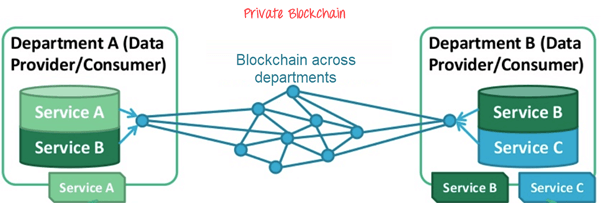
The non-public blockchain is at intervals one organization. It permits solely specific folks of the organization to verify and add group action blocks. However, everybody on the web is usually allowed to look at.
Consortium:
In this Blockchain variant, solely a gaggle of organizations will verify and add transactions. Here, the ledger is open or restricted to pick teams. pool blockchain is employed cross-organizations. it's solely controlled by pre-authorized nodes.
| To Get more knowledge on Blockchain: How did they work? What problems can it solve? and How can they use? Join Onlineitguru.....Blockchain Online Training Hyderabad. |
Comments
Post a Comment